
the Herald, 31 January 2014
HIGH levels of migration by Zimbabweans from the Matabeleland provinces to neighbouring South Africa and Botswana have resulted in greater HIV prevalence rates there, the National Aids Council has said. Appearing before the Parliamentary Thematic Committee on HIV/Aids on Monday, National Aids Council officials said while prevalence was decreasing in other provinces, Matabeleland South, Bulawayo and Matabeleland North's prevalence stood at 21 percent, 19 percent and 18 percent, respectively.
eNewsParkForest, 28 January 2014
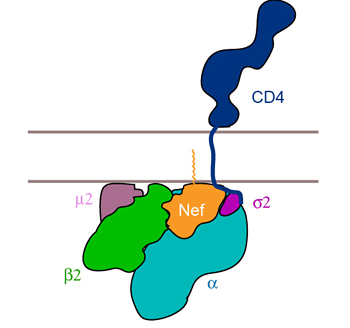 BERKELEY--(ENEWSPF)--January 28, 2014. People infected with the Human Immunodeficiency Virus (HIV) can stave off the symptoms of AIDS thanks to drug cocktails that mainly target three enzymes produced by the virus, but resistant strains pop up periodically that threaten to thwart these drug combos.
Researchers at the University of California, Berkeley, and the National Institutes of Health have instead focused on a fourth protein, Nef, that hijacks host proteins and is essential to HIV's lethality. The researchers have captured a high-resolution snapshot of Nef bound with a main host protein, and discovered a portion of the host protein that will make a promising target for the next-generation of anti-HIV drugs. By blocking the part of a key host protein to which Nef binds, it may be possible to slow or stop HIV.
JPNN, 30 Januari 2014
 CILEGON-Ketua Komisi Penanggulangan AIDS (KPA) Kota Cilegon, Edi Ariadi mengatakan warga kota itu semakin rawan terinfeksi virus HIV/AIDS. Selain dari pekerja seks komersial (PSK), narkoba, penyebaran virus mematikan itu juga bisa disebarkan oleh warga asing atau ekspatriat yang semakin marak bekerja di kota itu.
"Kota Cilegon ini rawan penyebaran HIV/AIDS. Sebab selain daerah transit antarpulau, juga merupakan lumbung industri. Terlebih ekspatriat banyak di sini. Termasuk warga Korea yang datang ke Kota Cilegon mungkin saja ada yang terinfeksi HIV/AIDS. Oleh sebab itu harus terus diawasi," terang Edi Ariadi yang juga Wakil Wali Kota Cilegon dalam kunjungan tim assistensi KPA Provinsi Banten ke Kota Cilegon, kemarin (29/1).
TribunNews, 28 Januari 2014

Laporan Wartawan Pos Kupang, Juan Tupen
TRIBUNNEWS.COM, KUPANG - Yayasan Tanpa Batas (YTB) selama ini terus melakukan advokasi dan pendampingan terhadap para pekerja seks komersial (PSK) jalanan maupun yang ada di lokalisasi Karang Dempel (KD) Kupang. Salah satu masalah yang sering ditemui adalah banyak tamu yang tak suka menggunakan kondom.
Supported by

© 2026 Kebijakan AIDS Indonesia