Methodology
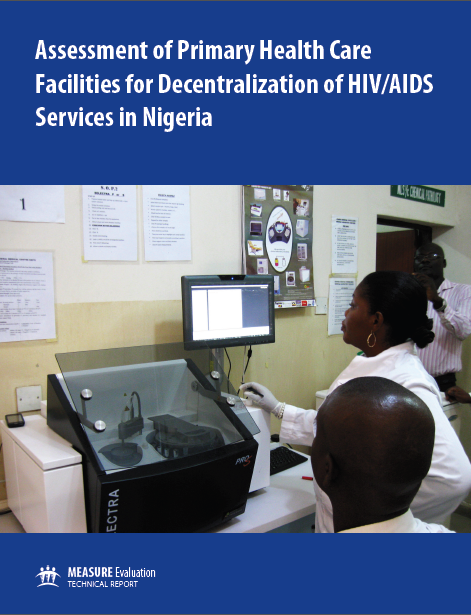 This assessment included different categories of primary health care (PHC) facilities, both in the govern- ment sector and those operated by nongovernmental or private organizations: health centers, health posts, comprehensive primary health care centers. The primary health facilities assessment in Nigeria 2012 con- sisted of two instruments: (1) the health facility assessment tool adapted from the Service Provision As- sessment (SPA) and Service Availability and Readiness Assessment (SARA); and (2) a service provider's questionnaire. The tools were administered to collect information on the general availability of health ser- vices, staffing, HIV services, drugs and pharmaceutical systems, waste management, laboratory facilities, community and donor relationship as well as budgetary allocation from the local governments.
This report presents data on various indicators of the availability, readiness and quality of services as well as results using a prioritization index from the 268 PHCs selected by the U.S. Government-PEPFAR agen- cies for their HIV services scale-up plan in 17 States and the Federal Capital Territory (FCT). The number of facilities assessed in each state ranges from four in Gombe, Yobe and Plateau states to 47 in Lagos state. This report is divided into two parts: the national summary narrative and each state report with information about the readiness for each facility to provide HIV services.
Key Findings
The evidence shows that the assessed primary health care facilities deliver some basic health services, par- ticularly the curative and preventive services such as ANC, deliveries, family planning/child-spacing, and HIV counselling and testing. Smaller percentages of the assessed facilities offer sexually transmitted infec- tion (STI) services, tuberculosis (TB) diagnosis and treatment, care and support for people living with HIV, PMTCT, and ART. However, there are striking differences in the service delivery environments among the states and within the facilities assessed in the states.
Selected Result Highlights
- Availability of basic amenities to support an enabling working environment and quality services (e.g., electricity or generator, emergency transportation system, and good sanitary practices) are poor in many of the facilities.
- The building infrastructures in many of the assessed facilities are poor with damaged ceilings, walls and windows. Kogi, Gombe, Taraba, Nasarawa, and Yobe states have more facilities in bad shape with respect to infrastructure.
- Although there are some facilities in some states with good waste disposal systems and practices, gener- ally, unsafe practices are commonly used for disposal of medical and sharps wastages such as bandages, unused needles and syringes. Open burning of contaminated waste is common (41% of assessed facili- ties), contributing to air pollution and disposal in unprotected areas is also common. Approximately 20% of facilities had evidence of safe medical waste and sharps disposal systems. One of the weakest elements was the availability of medical waste containers.
- The conditions for standard precautions for preventing infections at the outpatient service sites vary. The materials assessed include handwashing items (soap, water), latex gloves, surface disinfectant, and waste bins appropriate for disposal of contaminated waste. About 62% of the assessed facilities had materials for handwashing for standard precautions at the outpatient department site. This was particularly poor in Taraba, Kaduna, Benue, and Akwa-Ibom states.
- Drugs and medicine management including storage conditions are poor, which can affect the potency of the pharmaceuticals and contribute to wastage. Overall, Gombe and Edo states had the weakest drug storage systems. Poor drug storage systems could be attributed to a lack of pharmacy facilities in a large number of the assessed sites.
- There is poor linkage or support from the local government authorities (LGAs) beyond the payment of staff salaries. In addition, the community participation in support of PHC activities are evident but poor. It may be necessary and good to encourage the National Primary Health Care Development Agencies and their state counterparts to ensure the implementation of activities that will strengthen the commu- nity participation in the management of the PHCs (e.g., setting up or establishing a PHC committees to manage the facility and could also help in mobilizing local resources of the operations).
- The presence and number of health care workers in the states where the assessed facilities are located and within the states are unevenly distributed. There is also strikingly variation among the states located in the southern and northern regions of the country, regarding the presence of health care workers. For example, most of the assessed facilities in the northern region are headed or managed by community health extension workers as compared with either medical doctors or nurse/midwives heading many of the assessed facilities in the southern part.
- There is evidence of poor recordkeeping of the patients and clients using the facilities. Many of the as- sessed facilities reported they follow up with ART clients without coordinating with the ART service provider. They keep a list of clients whom they referred for ART then provide follow-up to improve adherence. These facilities do this informally at their own initiative maintaining no records that can provide information on drop-outs, deaths, persons who move, or those who are weak in compliance (e.g., those who do not keep appointments or may be late picking up their medications). These facilities would be prime candidates for a more structured follow-up system. Also, a number of assessed facilities could not produce the statistics for services delivered in the past three months. Some facilities are using the nationally prescribed data collection and reporting tools, but a significant number of the facilities are not using the national data collection and reporting tools that have implications for the health management information systems (HMIS) and the routine availability of information for program evaluations.
- PMTCT services
- Thirteen percent of the assessed facilities reported providing PMTCT services where they conduct the HIV testing but refer HIV-positive cases for antiretrovirals (ARVs) at other facilities. These facilities should be prime candidates for adding the ARV regimen to their list of services to improve compliance.
- Among the facilities reporting PMTCT and provision of the ARV (38%)
- Thirty-one percent had the first-line ARV regimen available.
- Sixty-nine percent had either the first line or the alternative for facilities with limited resources (AZT+3TC and neverapine at onset of labour).
- Drug logistics management is clearly an issue.
- Although some facilities offering PMTCT with ARVs had good scores for a service quality index developed for this assessment, many did not.
- ART services
- Few (4%) of the assessed facilities reported prescribing for ART. Among those who reported that they provide this service, 79% had one of the first-line ART regimens available. Among the assessed facilities, results for prescribing for ART varied across the states. All assessed facilities in Gombe State (100%) reported prescribing ART and 7% of the assessed facilities in Nasarawa state reported pre- scribing ART. There are no facilities among those assessed in 12 states that reported prescribing ART.
- Twelve percent of the assessed facilities reported conducting ART client follow-up without ART prescription. A larger proportion of the assessed facilities in Cross-River State (43%) reported ART client follow-up with no ART prescription compared with 8% of the facilities assessed in Akwa-Ibom and Kano States. None of the facilities assessed in Anambra, Bauchi, Benue, Lagos, Plateau, Rivers, Taraba, and Yobe states reported ART client follow-up with no ART prescription.
- Thirteen percent of the assessed facilities reported provision of care and support services along with ART prescription or client follow-up services. The state level information showed that 75% of the facilities in Gombe state reported offering care and support services along with ART prescription compared with 5% of the assessed facilities in Edo State providing care and support services along with ART client follow-up services.
Conclusion
Although the majority of the assessed facilities were observed to be functioning and providing a range of health services including HIV services, there is evidence of the need to strengthen systems to support qual- ity services. This assessment reviewed elements critical for supporting the quality for any health service. These include ensuring conditions exist for standard precautions to prevent transmission of infection, that pharmaceutical storage and management systems are strong, that qualified staff are present and that they have written service guidelines to promote adherence to service standards, and that data and records are maintained, so service assessments and program decisions are based on data.
These supportive elements are particularly important when considering services for HIV infections, due to the high mortality related to development of AIDS and the high cost for the ARTs and the burden this illness places on the total health system. The poor management and disposal of medical and sharps waste suggests a need for greater attention and emphasis on policies and practices for standard precautions to prevent infections. Lack of qualified health care workers in many of the assessed facilities points to the need for capacity building as well as deployment of qualified and adequate medical staff to the facilities if they are expected to commence or initiate HIV services.
The assessment evidence showed that the recordkeeping systems lack adequate human capacity and infra- structure to produce quality data for decision-making. This suggests that efforts should be made to improve the capacity and skills of those keeping the clients' and patients' information through training and con- tinuing supportive supervision with job-aids. For the long-term system strengthening efforts, the schools of public health and medicine should include data collection and reporting issues as well as data use. This will not only ensure that the graduates of such schools and institutions begin their service equipped with adequate data skills and fit into the system after employment, but also will strengthen the internalization of the importance of required health data for evidence based decisions.
There is a need for high-level of advocacy visits to the local government policymakers to ensure dilapidated building infrastructures in most of the assessed facilities are repaired or restored.
The findings suggest that a number of facilities are ready to commence HIV services, especially PMTCT and prescription of ARVs. However, there is a need to ensure availability of an enabling working environ- ment for the staff, storage and management systems to maintain the potency of the drugs being supplied to the facilities, to require the presence of guidelines and protocols on PMTCT and ART services, and to ensure quality assurance and control on the part of service providers. Some of the facilities already offering HIV services especially PMTCT and ART should be prioritized for interventions.
-

Assessment of Primary Health Care Facilities for Decentralization of HIV/AIDS Services in Nigeria
Created: Selasa, 08 April 2014 04:05 | Size: 11.44 MB | Downloads: 1,098