
- Details
- Category: Artikel Jurnal
- Hits: 3592
Alexandra Conseil,[1]* Sandra Mounier-Jack1[2] and Richard Coker[3]
 Hasil kajian tulisan Alexandra conseil dkk. Tentang integrasi sistem kesehatan atas dua program prioritas intervensi, HIV/AIDS dan TB di Vietnam, ke dalam 6 fungsi sistem kesehatan yang lebih luas menujukkan bahwa tidak satupun dari ke enam fungsi program terintegrasi secara penuh ke dalam sistem layanan kesehatan umum secara keseluruhan. Tingkat Integrasinya masih bersifat paralel pada tingkat struktural yang lebih tinggi atau terintegrasi sebagian saja. Temuan lain dari kajian ini juga menunjukkan bahwa terdapat integrasi yang kecil antar semua lintas tingkatan fungsi diantara program HIV/AIDS dan TB. Secara umum didapatkan gambaran bahwa antara lembaga internasional dengan stakeholder lokal masih masih bersifat vertikal dan pendekatannya kurang terintegrasi. Absennya asumsi dan tujuan bersama, polarisasi pandangan bisa berakibat kurang maksimalnya efisiensi dan efektifitas intervensi program HIV/AIDS dan TB di Vietnam.
- Details
- Category: Artikel Jurnal
- Hits: 4167
Adebiyi Adesina[1], Veronika J Wirtz[2],[3], and Sandra Dratler[1]
 Since antiretroviral (ARV) medicines represent one of the most costly compo- nents of therapy for HIV in middle-income countries, ensuring their efficient procurement is highly relevant. In 2008, Mexico created a national commission for the negotiation of ARV prices to achieve price reductions for their public HIV treatment programmes. The objective of this study is to assess the immediate impact of the creation of the Mexican Commission for Price Negotiation on ARV prices and expenditures.
A longitudinal retrospective analysis of procurement prices, volumes and type of the most commonly prescribed ARVs procured by the two largest providers of HIV/AIDS care in Mexico between 2004 and 2009 was carried out. These analyses were combined with 26 semi-structured key informant interviews to identify changes in the procurement process.
- Details
- Category: Artikel Jurnal
- Hits: 5552
Rini Sasanti Handayani[1], Yuyun Yuniar[1], dan Ully Adhie Mulyani[2]
Latar belakang
Antiretroviral (ARV) adalah obat HIV–AIDS yang berfungsi mengurangi varemia dan meningkatkan jumlah sel-sel CD4+. Meskipun tidak untuk menyembuhkan, ARV meningkatkan harapan hidup ODHA (orang dengan HIV–AIDS). Tingkat kepatuhan sangat memengaruhi keberhasilan terapi ARV, padahal ARV harus digunakan seumur hidup. Akibatnya sering menyebabkan kebosanan/kejenuhan, dan pada akhirnya menjadi drop out. Pemaknaan ARV oleh ODHA merupakan salah satu faktor yang menentukan kepatuhan ODHA menggunakan ARV.
- Details
- Category: Artikel Jurnal
- Hits: 4319
Nathan J Lachowsky[1],[2],[3]*, Peter JW Saxton[4], Nigel P Dickson4, Anthony J Hughes[5], Alastair JS Summerlee[6] and Cate E Dewey1,2
 Background
Understanding HIV testing behaviour is vital to developing evidence-based policy and programming that supports optimal HIV care, support, and prevention. This has not been investigated among younger gay, bisexual, and other men who have sex with men (YMSM, aged 16-29) in New Zealand.
Methods
National HIV sociobehavioural surveillance data from 2006, 2008, and 2011 was pooled to determine the prevalence of recent HIV testing (in the last 12 months) among YMSM. Factors associated with recent testing were determined using manual backward stepwise multivariate logistic regression.
- Details
- Category: Artikel Jurnal
- Hits: 4911
Methodology
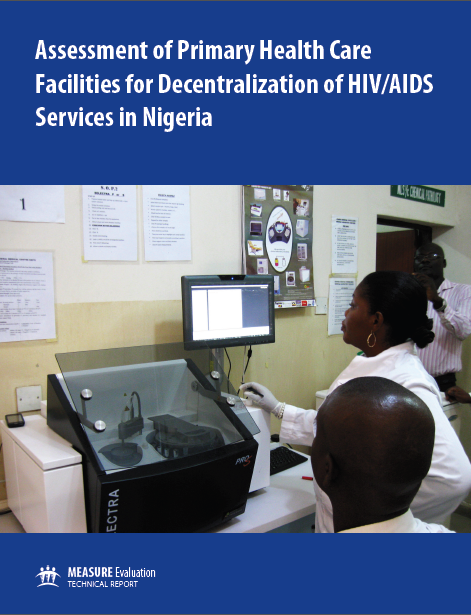 This assessment included different categories of primary health care (PHC) facilities, both in the govern- ment sector and those operated by nongovernmental or private organizations: health centers, health posts, comprehensive primary health care centers. The primary health facilities assessment in Nigeria 2012 con- sisted of two instruments: (1) the health facility assessment tool adapted from the Service Provision As- sessment (SPA) and Service Availability and Readiness Assessment (SARA); and (2) a service provider's questionnaire. The tools were administered to collect information on the general availability of health ser- vices, staffing, HIV services, drugs and pharmaceutical systems, waste management, laboratory facilities, community and donor relationship as well as budgetary allocation from the local governments.
This report presents data on various indicators of the availability, readiness and quality of services as well as results using a prioritization index from the 268 PHCs selected by the U.S. Government-PEPFAR agen- cies for their HIV services scale-up plan in 17 States and the Federal Capital Territory (FCT). The number of facilities assessed in each state ranges from four in Gombe, Yobe and Plateau states to 47 in Lagos state. This report is divided into two parts: the national summary narrative and each state report with information about the readiness for each facility to provide HIV services.
Supported by

© 2026 Kebijakan AIDS Indonesia