
- Details
- Category: Artikel Jurnal
- Hits: 4115
Rifat Atun[1], Thyra de Jongh[2], Federica Secci[3], Kelechi Ohiri[4] and Olusoji Adeyi[4],[5]
A longstanding debate on health systems organization relates to benefits of integrating health programmes that emphasize specific interventions into mainstream health systems to increase access and improve health outcomes. This debate has long been characterized by polarization of views and ideologies, with protagonists for and against integration arguing the relative merits of each approach. However, all too frequently these arguments have not been based on hard evidence. The presence of both integrated and non-integrated programmes in many countries suggests there may be benefits to either approach, but the relative merits of integration in various contexts and for different interventions have not been systematically analysed and documented.
- Details
- Category: Artikel Jurnal
- Hits: 5590
Amirudin [1], Ridad Agoes [2], Irvan Afriandi [3]
Latar belakang: Peningkatan temuan kasus HIV/AIDS diberbagai daerah akhir- akhir ini terjadi peningkatan diprediksi sebagai bagian dari meningkatnya peran Komisi Penanggulangan HIV/AIDS Daerah (KPAD). Diperlukan keterlibatan pemangku kepentingan terkait penanggulangan AIDS dalam penanggulangan kasus ini. Adanya persepsi yang berbeda dari pemangku kepentingan terhadap fungsi KPAD sangat berdampak pada keberlangsungan penanggulangan HIV/AIDS masa yang akan datang.
- Details
- Category: Artikel Jurnal
- Hits: 4825
Lessons learned from national-level efforts in Haiti, Uganda and South Sudan
Summary
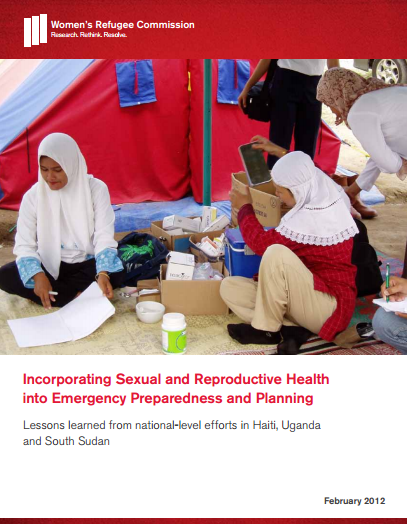 This report reviews recent Women's Refugee Commis¬sion sexual and reproductive health activities (SRH) in Haiti, Uganda and South Sudan. It considers the impact of advocacy, training and planning activities related to emergency preparedness and planning specific to SRH. The report then offers lessons learned and rec¬ommendations for improving steps towards SRH emer¬gency preparedness at the national level. As efforts to incorporate SRH activities into disaster risk reduction (DRR) are in their early phases, this report makes an important contribution to a knowledge base that could help to shape effective practices. It is essential that we expand this knowledge base to reduce reproductive health morbidity and mortality and ensure that women and girls have full access to response systems, during and post-disasters, by taking critical preparation steps.
- Details
- Category: Artikel Jurnal
- Hits: 5444
Penulis: Tim Universitas Indonesia(1) Zaki Dinul, (2) Kurnia Sari, (3) Mardiati Nadjib
Tulisan ini merupakan Reportase tim PKMK saat penyelenggaraan Konferensi Nasional InaHEA. Sebagai penyaji presentasi adalah Zaki Dinul.
 PKMK – HIV/ AIDS merupakan salah satu permasalahan kesehatan dunia yang membutuhkan biaya pengobatan mahal. Orang Dengan HIV/AIDS (ODHA) cenderung mengeluarkan biaya sendiri yang cukup besar termasuk pelayanan rawat jalan. Semakin lama pengobatan yang dilakukan justru makin meningkatkan OOP HIV/ AIDS. Berdasarkan data UNAIDS tahun 2013, Zaki menyatakan bahwa ada 610.000 kasus di Indonesia bahkan 1.005-nya terjadi di Jakarta Timur.
- Details
- Category: Artikel Jurnal
- Hits: 4939
Mardiati Nadjib, Amilia Megraini
Fakultas Kesehatan Masyarakat Universitas Indonesia
Background:
There have been question on how much the Government spent for priority programs, including HIVAIDS. For example, are the MDGs targets (TB, Malaria, HIVAIDS, maternal care etc) achieved as expected and the relevant programs received adequate funding? In this regard, spending for priority programs need to be captured. Unfortunately, very limited data on spending on priority programs that can be used as lesson learned to see government contribution on specific health programs. Many publication or study result depicted the detail budget or spending, but we cannot simply compare it with NHA data on health expenditures. NHA uses specific classification namely SHA (System of Health Account), while up to now perhaps only NASA uses similar classification but uniquely relevant to HIV and AIDS.
Supported by

© 2026 Kebijakan AIDS Indonesia