Lessons learned from national-level efforts in Haiti, Uganda and South Sudan
Summary
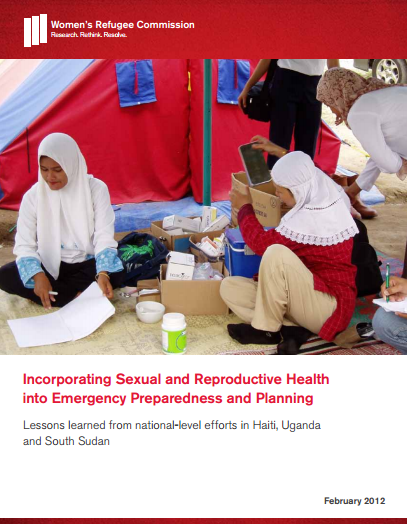 This report reviews recent Women's Refugee Commis¬sion sexual and reproductive health activities (SRH) in Haiti, Uganda and South Sudan. It considers the impact of advocacy, training and planning activities related to emergency preparedness and planning specific to SRH. The report then offers lessons learned and rec¬ommendations for improving steps towards SRH emer¬gency preparedness at the national level. As efforts to incorporate SRH activities into disaster risk reduction (DRR) are in their early phases, this report makes an important contribution to a knowledge base that could help to shape effective practices. It is essential that we expand this knowledge base to reduce reproductive health morbidity and mortality and ensure that women and girls have full access to response systems, during and post-disasters, by taking critical preparation steps.
Introduction
It is well documented that women are disproportionately affected by disasters: 90 percent of those killed in the 1991 cyclone in Bangladesh and 80 percent of those killed in the 2004 tsunami were women and girls.1 Gender differences in loss of lives due to natural disasters are directly linked to a woman's economic and social rights before the crisis;2 these rights affect one's ability to access warning systems, survival skills and rescue mechanisms. For women and girls who do survive these events, the immediate impacts of a disaster—displacement, sexual violence and exploitation, disruptions in health services and loss of financial security within a family unit—often lead to devastating, long-term effects, including SRH-related death and illness.
Planning and preparing for disasters can help to address these gender imbalances, as well as improve access to critical life-saving SRH services during an emergency.
To this end, the Women's Refugee Commission (WRC) has supported global-, national- and community-level efforts to plan and prepare for disasters. The WRC fa¬cilitates the RH sub-working group of the International Strategy for Disaster Reduction (ISDR)3 at the global level, which is currently developing policy and program¬matic tools that support the incorporation of SRH into Health Emergency Management (HEM). The WRC is also involved in national- and community-level activities to support a similar objective. During 2010 and 2011, the WRC conducted activities in Haiti, Uganda and South Sudan in order to better understand es¬sential steps, capacities and chal¬lenges when incorporating SRH into HEM. The WRC provided training and technical assistance for emergency preparedness and planning, in relation to SRH in each country, supporting the priority areas within the Hyogo Framework for Action. This docu¬ment describes these activities and presents what was learned from these efforts.
Background
The importance of planning and preparing for disasters is understood as a critical step to reducing loss of lives during emergencies. Over the past two decades, the number of recorded natural disasters has doubled.4 In addition, vulnerability is growing in many countries due to a variety of factors, including urbanization, population growth, unplanned settlements, poverty and HIV prevalence.5 The ISDR was adopted by the United Nations in 2000 as a strategic framework to build resilient nations and communities, so that they are better prepared for such disasters. This helped to institutionalize DRR as a global priority. The Hyogo Framework for Action is the key instrument and global blueprint for implementing DRR activities. It aims to build resilient nations and communities and reduce losses from disaster by 2015, through five priority actions: 1) ensuring DRR is a national and local priority; 2) identifying, assessing and monitoring risks and enhancing early warning systems; 3) building a culture of safety and resilience at all levels; 4) reducing existing vulnerabilities; and 5) strengthening preparedness and response at all levels.
-

Incorporating Sexual and Reproductive Health into Emergency Preparedness and Planning
Created: Selasa, 18 Februari 2014 08:38 | Size: 1.03 MB | Downloads: 1,011